

T - THERMAL MASS (T-M)
When used correctly, materials with high thermal mass (T-M) can significantly increase thermal comfort and reduce energy use in your home. T-M acts as a thermal battery (a battery of the sun’s warm rays) to moderate internal household temperatures by averaging out day−night (diurnal) extremes.
In winter, T-M can absorb heat during the day from direct sunlight and then re-radiate this warmth back into the home throughout the evening and overnight.
Designing with T-M is the understanding of different material’s ability to absorb and hold heat and how we can manage that ability to our advantage. It considers climates, seasons, solar access and how different materials react to direct sun exposure and air temperatures.
Our considerations with T-M include:
1. The type, amount and placement (location) of materials in a home.
2. The materials unique conductivity & resistance to heat-flow, and,
3. Their level of exposure to direct sun, the natural heat source.
Each home should plan to have adequate/ correct thermal mass to allow the optimum reaction to outside temp changes. We can decide how much thermal mass we want in our house (including if any at all) and where we should put it (if we have it.)
As a broad rule, colder climates would prefer high T-M materials, to capture any available sun and heat, whilst homes in hot climates may not want any high T-M materials, preferring for homes there not to absorb any heat. A dark stone house in Hobart is ideal, whilst a white painted-timber house in North Queenland is too, as both are climate appropriate.
Many animals sleep (and hibernate) underground in dens/ burrows, knowing the soil of planet earth is always around 18 degrees ℃, including in hot deserts and in very cold climates. The earth’s core is a constant temperature as the earth has a high thermal mass and we can replicate that principle in our homes through design.
18℃ is close to an ideal temperature for humans and is something we seek for our buildings.
From a base of 18℃, we can easily adjust our home’s temperature for further personal comfort, even with just a jumper and a mild heat source like an hour of direct morning sun. Whilst we don’t live underground, we can also anchor (connect) our home to the earth’s stable mass (via a slab), so that no matter what the air temp is outside, it can be close to 18 degrees inside. One common method of anchoring is via a high T-M floor slab.
We can be cleverly specific in our selection and placement of materials so that, for example, if we wanted to absorb the sun’s heat in a specific room, we could design in a dark-coloured stone (material) wall and place it in the winter sun’s path to absorb its heat there. An exposed concrete floor, similarly, sitting behind double-glazed glass, soaking up the winter sun is also an ideal set-up, staying warm and re-radiating free gentle heat at night.
Should we wish for our building not to absorb heat, we then would choose, for materials that are exposed to the sun, those that won’t absorb heat, such as a light coloured timber. Earlier ‘Queenslander’ homes in Northern Australia show great application of Thermal Mass principles, being usually white, made of timber and with wide verandas.
Whilst materials generally stay in place in the home (like a concrete slab), and can’t be moved easily, we have some controls over thermal workings, such as leaving a floor exposed to the sun in winter, then covering it with a rug in summer.
Whilst thermal mass is the ability of a material to absorb, store and release heat, thermal lag is the rate at which a material absorbs, stores and releases heat. For most common building materials, the higher the T-M, the longer the thermal lag.
Thermal lag is influenced by these aspects of a material: heat capacity, conductivity, thickness, surface area, texture, exposure to air movement, colour, surface coatings and more.
For example, dark, matte or textured surfaces absorb and re-radiate more energy than light, smooth, reflective surfaces. We see this lag in effect, in a negative way, with the common dark concrete roof tiles that sit atop many new Australian homes. They soak in the summer sun’s intense heat all day, staying hot long after sun-set. It’s like having an unwanted heater on top of a house on a hot summer day. Usually, a light colour roof would be a better choice in a hot climate.
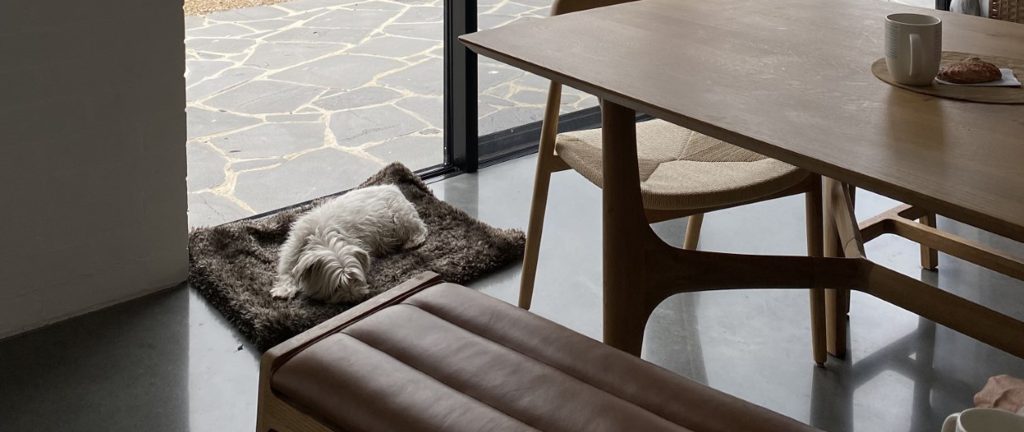
Thermal Mass. This house has a concrete floor on its Northern side and enjoys the benefits of solar passive heating from it, as the sun falls on the high TM floor at the times of the year when it’s wanted. The sun does not reach to the rear of the house to shine on and warm the concrete floor there, nor does it need to, as the Northern part of the floor absorbs and emits enough heat to warm the house in winter. For a better balance of the TACTICS principles, the rear of the house could have used renewable (and possibly also re-cycled) timber flooring, instead of concrete, and then the house would be both naturally warm (from the sun-warmed floor) and also include some lovely timber flooring, a more sustainable resource.
Specific Thermal Mass (T-M) Applications:
- Materials with high T-M and long lag times are typically heavyweight materials like concrete and brick.
- Materials with low T-M are typically lighterweight, like timber.
- Unplanned T-M placement makes a home less comfortable and increases energy bills.
- High T-M is most beneficial in climates with a measurable difference between day and night temperatures.
- Good T-M planning helps to passively heat your home at low cost.
- T-M needs to be combined with other TACTICS principles (such as good insulation and gap sealing) to be most effective.
- High T-M is best incorporated in your floor (for example, concrete slab) or walls (with a reverse-brick-veneer construction).
- In cooler situations, T-M should absorb and re-radiate close to its full heat storage capacity in a single day–night (diurnal) cycle.
- Reverse-brick-veneer, rather than the traditional brick-veneer, is better for internal temperature stability and comfort.
- Direct sunlight onto bedroom walls in cooler climates (such as via celestial windows) is a great T-M design strategy.
- Consider roof colour carefully, knowing that darker roofs absorb far more heat.
- Plan how the size/ location of your windows match the sun’s movement and your T-M needs.
- Consider using both fixed-in-place external and also movable shading options, and use them to control the sun’s effect on your home’s T-M.
- Designing to optimise T-M in a home is best done at the design stage, as it’s much easier to change a drawing than an actual wall or floor.


Stay connected! Follow us on our blog or socials for the latest updates, education and much more!
Quick Links
Get In Touch
© All Rights Reserved.