

Self-Assessment is possible to do in every home and in any season.
SUSTAINABLE HOME TOPICS ON THIS PAGE GIVE CONTEXT TO THE 7 PRINCIPLES
Page Table Of Contents
- Introduction and Context
- Topics of Sustainable Housing
- Apartments
- Green Leases for Tenants / Landlords
- Building Life-Cycles, Adaptive Re-Use
- Life Cycle Costs of Buildings
- Solar Passive Building Design
- 4 Types of Energy use
- Designing for Climate
TACTICS
T – Temperature Stability
A – Acclimatisation. Orientation, Floorplans
C – Components and Materials
T – Thermal Mass
I – Internal Airflow. Ventilation, Drafts. Seals
C – Cost Efficiency. Energy Efficiency.
S – Smaller and Less
Introduction
CESH TACTICS uses 7 principles of Sustainable Building Design to assess a home’s design, construction, operation and use.
TACTICS outlines and guides on what to consider when assessing new home plans or changes to an existing home.
TACTICS reveals where changes will improve a home so it’s more thermally comfortable and energy-efficient (EE).
An assessment is designed to lead into direct action.
There is no single ‘right’ change or procedure to follow, rather, it’s a set of guidelines which, if followed even just in part, will give benefits.
TACTICS shows us how to reduce our reliance on appliances and switches. Instead of finding comfort with high financial cost and carbon emissions, we learn how to become comfortable in a way that’s also less harmful to the environment, to ourselves financially and to future generations. Via its 7 principles, TACTICS helps to design/ retrofit/renovate and use buildings that will;
- Hold a comfortable temperature on their own, passively, by being better suited to their climate.
- Direct natural sun-light and warmth to the right areas of the home.
- Improve home liveability by improving airflow, sealing gaps and using materials better.
- Increase the building’s value, and more.

Improved Energy Effficiency (EE) and Internal Air Quality (IAQ) are a benefit of adopting TACTICS principles.
Topics of Sustainable Housing: Discussion points
Why do houses face the street, and not the sun?
Traditions and habits in Australian housing dictate that we design our homes to look good from the street, focusing on an impressive entry to show to visitors and neighbours. As we also build our housing in street ‘blocks,’ only (roughly) 1 in 4 homes may then have living rooms facing the sun, whilst many living rooms are (sadly) on the darker sides of a house.
Change of focus from quantity to quality. Change from maximum-m2 to comfort and efficiency.
Australian (and USA) homes are the largest in the world. We have sacrificed quality in the pursuit of more m2, but with clever design we can reduce size and better use our building and financial resources for added comfort and longer house life.
To compare, why do cars still need constant A/C during a journey when a car’s cabin is so small?
Just like most housing, cars are not designed or built for thermal comfort. Their steel and glass materials, lack of insulation, gaps and other issues all result in their inability to hold a good temperature without constant A/C or heating.
Houses with the same lack of sustainable design as cars have are just as difficult to keep at a comfortable temperature.
The difference between Energy Efficiency (EE) and Sustainability:
EE measurements are straightforward, using common tools, science, math. It’s simply the amount of power used in a home.
Sustainability is more difficult to define, rate or grade and it extends far beyond EE.
Being sustainable is about meeting our needs without reducing the ability of those in the future (children/ grand-children/ others) to also be able to meet their needs.
The 1m2 gap in each home’s walls. A big surprise.
Surprisingly, adding up all the gaps in a typical Australian house gives a size of 1m2, which means that whilst we try to heat or cool our homes, we have only limited control over our indoor environment. Filling gaps is the first step to temperature control and comfort.
The average NatHERS rating for Australian homes, for EE, is around 1.8 of 10 Stars.
Whilst recent homes were built to the regulated standard of 6/10 Stars (and soon to be 7) millions of homes were built before those regulations began, meaning many homes have temperature control only slightly better than a camping tent. With an average rating of less than 2 in 10, it’s no surprise that people struggle through the seasons and often get bill shock when seeking comfort.
How buildings affect the climate and how the climate affects buildings.
Building damage and cost damage. Climate change is a 2-way relationship. As we build and retrofit, we need to be aware that just as we continue to cause more damage to the climate, the changing climate is also increasingly damaging buildings. This is seen in the ever larger and more frequent floods, storms, extreme heat days, bush-fires (and insurance premiums).
Preventing an issue via good planning is easier than managing an issue.
The more we plan, the more we can manage buildings for our long-term benefit. Things we do in the design and construction phases can greatly benefit us in the long occupancy stage of a building’s life.
Sustainability is the 4th element of architecture.
General good building design acknowledges 3 key elements of architecture; function, structure and beauty (aesthetics.)
To these we now also blend in sustainability so the home then increases in functionality, is of better quality (structure), is still (or is even more) beautiful and is now also more sustainable.
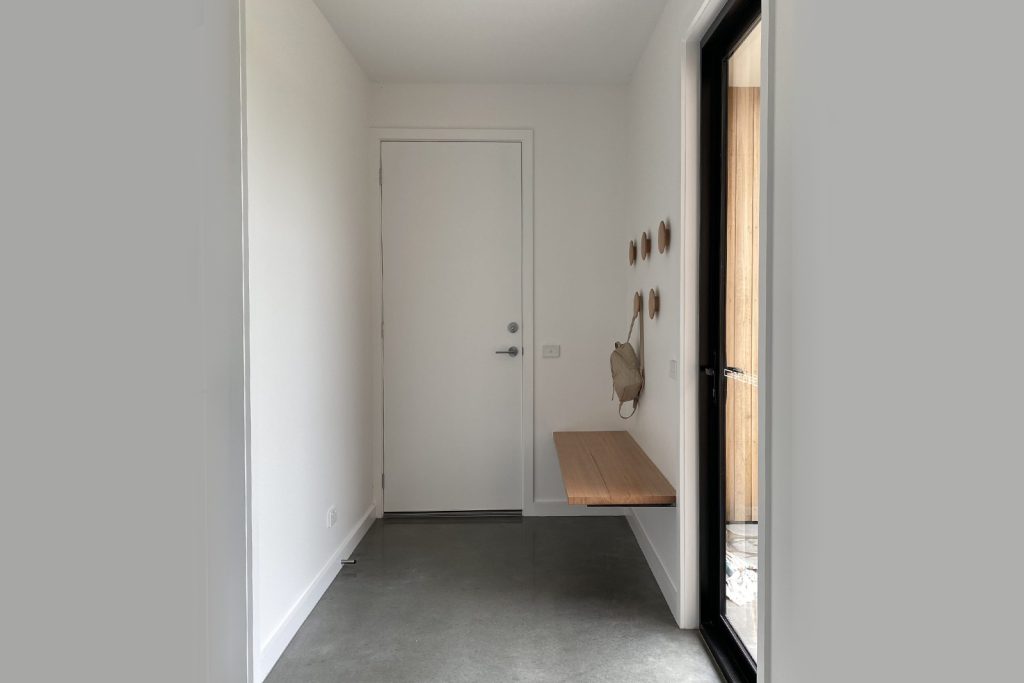
An Airlock (a small room at an external door) is a highly effective way to maintain a stable home temperature. It’s a easy inclusion at the time of design and doubles nicely as a ‘mud’ and cloak room.

More sustainable material use is an outcome of adopting TACTICS principles and making better-informed decisions on material type, quantity and placement.
Apartments
With an increasing number of Australians living in apartments, it’s important to note that many elements of TACTICS apply to apartments also, even to high-rise. With apartments the design stage is of special importance as it’s more difficult to make changes to an existing apartment building than to a house. A house is easier to retrofit, as it’s accessible from the ground (and from all sides) and usually has just a single owner as the decision maker.
Apartments have particular TACTICS options and factors to consider due their taller size and make-up. More complex internal room placement, shading (from balconies above), material choices, directional thermal-mass options, insulation (sound proofing), and internal air-flow paths should all be addressed as to how they can best work in a particular apartment building.
Not all apartments can be on the preferred North side of a building and each side of the building needs a bespoke floorplan design approach.
The balance of importance of the 7 TACTICS principles varies between different apartment buildings/types. The building aspects that can make a large difference to the occupant’s life should be the most considered. An example of this is airflow. If without the opportunity to cross-ventilate through an entire building (from end to end), how to achieve good ventilation and airflow in an apartment should be at the top of the designer’s mind.
For existing apartments, options for positive change are possible too, such as removing an existing carpet to expose the concrete floor to the winter sun (and so be able to absorb natural winter heat) and then also putting a rug down again in summer.
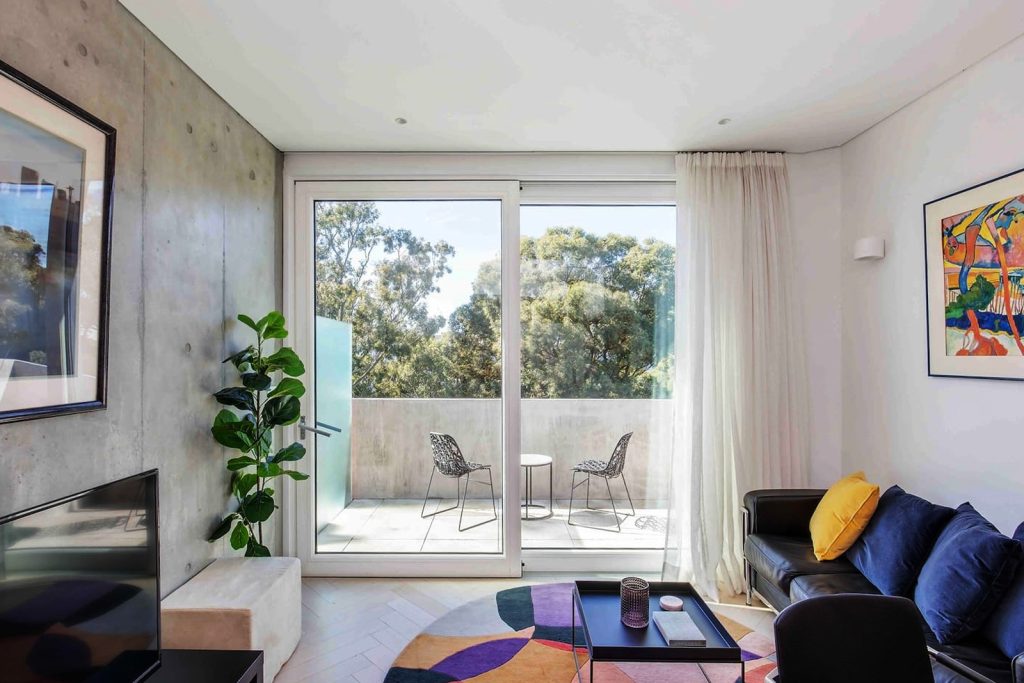
Here’s an example of a North facing apartment. The winter sunlight enters the DG window and warms the high thermal mass concrete of the living room wall, using the morning sun (when it’s rising in the sky) as a heat source.
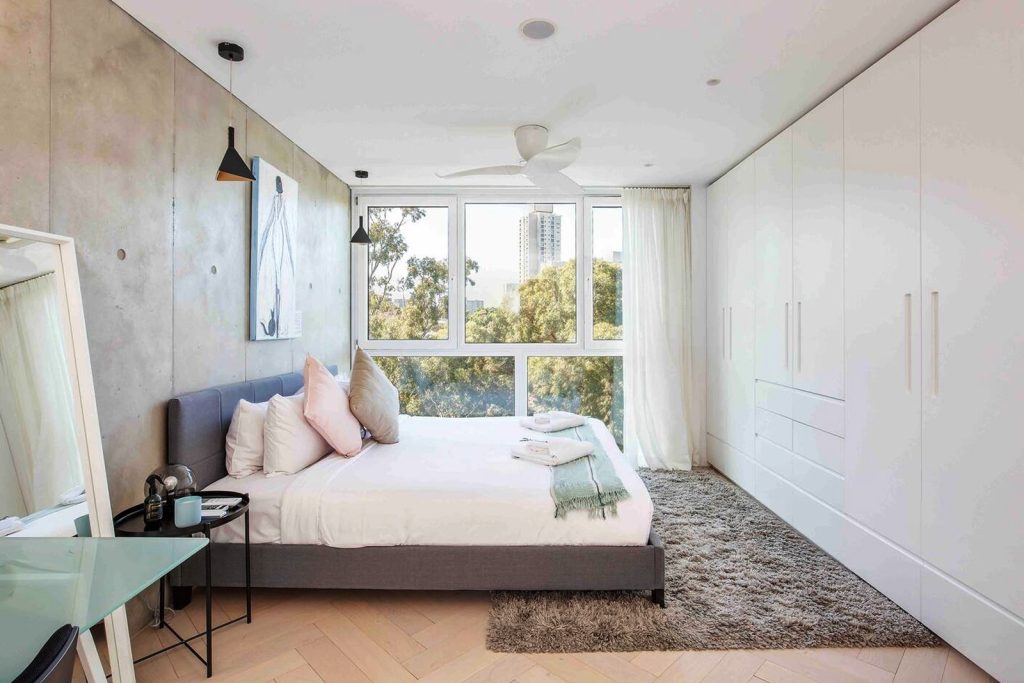
Here’s an example of a North facing apartment with a timber floor. In this case the timber has low thermal mass and would not absorb heat well, which was the desired out come in the hot climate this apartment is in.
Green Leases. Tenants, Landlords and a Win-Win-Win Scenario

Sitting down for a good chat between tenants and landlords can lead to mutuallly beneficial changes to a property.
Rental property options.
For homes where the owner and tenant are not the same, a different approach is taken to making positive change. Previously, an owner of a rental property would be the one to pay for an improvement (such as gap sealing) whilst the tenant recieved the beneft of the improvement (such as a warmer home, lower power bills). This set-up often gave resistance to making such property changes, as many residential landlords saw no reason to make property improvements that they would not immediately and directly benefit from.
The Commercial Real Estate (CRE) sector has managed this scenario very well though, through agreements like GREEN LEASES, where, in essence a tenant agrees to pay a higher rent in return for improvements to the building. These leases bring both parties together in a mutually beneficial way. A good example is when the owner of a house pays to install Solar Panels and a reverse-cycle AC/Heater, and the tenant agrees to pay $30/week more rent. In this way, the owner is rewarded for their capital outlay from increased income, the tenant gets free daytime power and a cooler home, and the planet sees less coal-burning emissions. There is often also an increase in the value of the property, as it’s been improved.
Such a Win-Win-Win scenario can come about just from a discussion.
Commercial retrofit reference below:
Building Life Cycles and Adaptive Reuse
Understanding the long-term nature of housing means knowing that running costs over time are as important a consideration as the up-front (construction) cost. We we can save money in the long term via good decision making.
Studying the Life-Cycle of buildings, also called the Cradle-to-Grave analysis, reminds us that buildings have a life cycle not too different from ours. They have a gestation stage (planning, procurement), are born (constructed), live a life (their ‘use’ phase), die (end of that use) and often are buried (end-of-life-stage.) Or, sometimes buildings don’t ‘die”! Buildings can be reused and given an extended life, a much better outcome that is far more sustainable.
How long a building can be adaptively reused and continue to ‘live for’ largely depends on their build quality and if they were designed in a way that easily allows structural changes and other/ new uses. Adaptive-Reuse, a form of future-proofing (and extending building life) is where we design a building to suit many needs/wants. Extending a building’s life through adaptive reuse and sustainable features is a great form (and scale) of reuse/ recycling. Recycling a house is far more impactful than just recycling a bottle. Rather than ‘demolish and re-build’, analysis of adaptive re-use possibilities of a building can reveal many low cost and low emmission options.
"Being sustainable means thinking long-term"
Life-Cycle Costs (LCCs) of Buildings.
Financial considerations of a building’s life-time costs. A building’s life-cycle (from the topic above) is also related to its Life-Cycle Costs (LCC), which are the total costs over its life including both construction and (on-going) running costs. A cheaper ticket price on any poorer quality item often leads to higher running costs in the long term and our aim is to design/ build homes that last for the longest time, whilst also having the lowest (or no) cost to run. Saving a dollar in the building stage may cost ten dollars more over the life of the building, if it’s not a well considered decision.
For example, deciding not to spend $1000 to put a sun-shade over a window, might later cost $3’000 for an Air-Con unit, hundreds of dollars in maintenance/ repairs of the unit, and hundreds more dollars in annual electricity bills.
For new buildings, additions and also retrofits (renovations), a prime objective is to minimise its negative impact on the environment through Life-Cycle Analysis of the building. There can be dozens of decisions (choices) to be made for every building, each of which can have a positive (or negative) effect for decades.
Solar Passive Building Design
Solar Passive Building Design aims to achieve high levels of thermal comfort and energy efficiency via orientation, correct material selection, insulation, airtightness, window/ door design, and other aspects of TACTICS.
Solar-Passive Heating means heating without any moving/mechanical parts. It means trapping heat from the sun inside your home and using thermal mass, good glazing and insulation to store and distribute the heat. It significantly reduces energy bills and is useful in nearly all climates, including the moderate climates in Southern Victoria. The key method to achieving solar passive heating is to place living areas on the North side of your home, and include north-facing windows that let direct sun reach materials of high thermal mass in colder months. Preventing cold air from entering your home by including airlock rooms, or sealing around doors & windows helps passively also.
(We will discuss this further under other topics of TACTICS below.)
Solar-Passive design principles are easiest to adopt when designing/ building a new home (‘a clean slate’), though most features of passive design can also be added through renovations/ retrofits and other home improvements.
Solar Passive Design standards don’t have numerical performance targets, nor do they dictate specific materials or products to use, so it can be approached in various ways. We are seeing an increased adoption of Solar Passive Design principles in Southern Australia, as it works well in the climate here.
Energy Use and How Much Power Your Home Really Has Used
The electricity used daily in a home is just 1 of the 4 types of energy used in making and running that home. Most people are surprised to learn that their daily use of energy is only around ½ of the total energy use that their home is responsible for. Whilst the % breakdown between these 4 energy use types varies from building to building, depending on materials, location etc, with careful analysis we can best manage/ reduce them in every case. The 4 considerations of a building’s environmental impact via energy use and releasing harmful emissions are below.
The 4 Types of Energy Use a Home is Responsible for
- In-Use Energy. Ongoing (daily) energy use for heating, cooling, cooking etc. Our goal for in-use energy is to lower it and to use green energy sources as much as possible.
This In-Use energy is around half of all the energy use a home is responsible for.The 3 types of energy use below together are around half of a home’s energy use.
- Embodied Energy. A building’s total embodied energy is the energy expended to create it. It includes the manufacturing and transport of materials (including their extraction/ mining), its packaging, and the energy involved in assembling the building.
The less new embodied energy we create, the better.
- Locational and Transport Energy. Emissions related to the location of (and workers travelling to) the site. Here we seek local/ short options on all things that travel.
- Disposal Energy or re-use/re-cycling energy. This is the total energy used in demolition, contamination clean-up, waste transport and disposal, re-cycling or other processing, etc of the building. The less energy we use for this, the better.

Designing For Climate
‘Designing for climate’ means that a home is designed or modified to suit and work well in the climate it is in (both now and in the future), so that it keeps occupants thermally comfortable whilst using minimal heating or cooling.
Design for climate requires the use of Solar Passive design principles of TACTICS and good EE behaviour by the occupants.
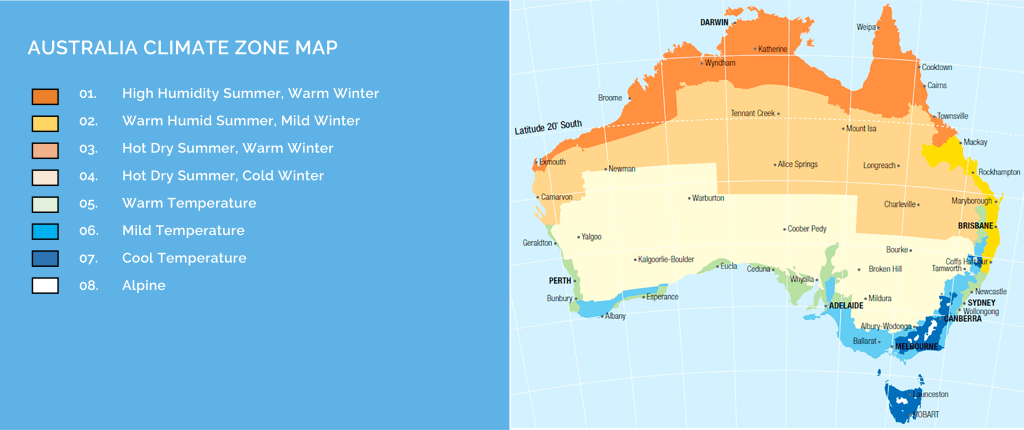
Designing for climate considers a home’s location in terms of sunlight, temperature range, rainfall, wind, topography and other unique locale factors
Australia has 7 varied climate categories (per the image above) and each of them requires a specific approach to greener housing. Melbourne is in a mild-temperate climate with four distinct seasons. Summer and winter exceed the human comfort range whilst spring and autumn are ideal for human comfort. The main aims in a mild-temperate zone are to reduce the need for cooling in summer and especially to reduce the need for heating in winter. Happily, this zone type offers good cost-effective opportunities to achieve energy-efficient outcomes.

In a hot climate, a natural timber floor designed to allow air-flow beneath it is a time-proven natural way to assist with cooling.
(Reference: The traditional ‘Queenslander’ house style.)
The Southern Victorian climate has:
- Hot/ very hot summers, moderate humidity, but also getting hotter, longer and more humid.
- Mild to cool winters, low humidity, and,
- Low day–night (diurnal) temperature range.
The climate variables to consider when planning for a home are the climate’s ambient temperature, daily hours and position of the sun, wind (amount, direction and strength), rain (amount, frequency, heaviness, directions, seasons), hail (size, frequency), sweeping ‘cool-changes’, and topography.
We can often find clues for how best to design for a climate by looking at the houses built there before electricity was invented, as in those times residents relied on natural ways to be comfortable (and as animals still do.) We recognise that early homes of Melbourne featured several passive design principles, such as wide verandas, smaller living rooms (for warmth) and canvas shades, many things we also can re-adopt.
When designing or renovating a home, consider potential climate change impacts likely to affect your area. Include design features in your home that can cope with these impacts whether they are related to ambient temperature, or, perhaps related to weather changes such as increased rainfall or extreme heat spells.
CESH TACTICS
If you are ready for improvements, the self-assessment modules are ready for you now,
or you could contact us for a group talk or site visit.
For any queries, simply fill out the form on the contact page or email us.
Email: info@cesh.com.au
TACTICS Information and Home Self-Assessment: Free at any time.
CESH TACTICS: Melbourne on-site talks and assessments: available through request.
CESH ABN: 63 247 066 902
Stay connected! Follow us on our blog or socials for the latest updates, education and much more!
Quick Links
Get In Touch
© All Rights Reserved.