

A - ACCLIMATISATION
Acclimatisation is about Building Orientation and Internal Room Placement.
Designing around the solar axis is the key here, knowing that the winter sun passes by low in the Northern sky and that the summer sun passes high above us. We can use solar design to capture winter sun and to also block summer sun as needed. We seek to capture as much winter sun in our daytime (living) rooms as possible, for the home to receive natural warmth and natural light. As the path of the sun differs between seasons, its ideal to orient our home, rooms and windows to match these paths, so that differences in the 4 seasons can be used to our advantage.
Acclimatisation via Orientation.
Orientation is consideration of how the sun moves across the sky, of the seasonal changes (height, timing, length) of its path and how we position and orientate our home in relation to it.
Orientation is a critical aspect to address early in the building design process (and well before a building is constructed), as any orientation change is difficult to do at later construction stages.
Benefits and savings obtained from spending a few moments on good orientation during the early planning stages last for decades (even centuries) and usually at no extra cost to the build.
In Melbourne (in the Southern Hemisphere) we orientate our homes to the Solar North so daytime living areas (best with large north facing windows), receive the winter sun. We also design for our sleeping rooms to be on the cooler/ darker South side of the house, where there are ideal sleeping conditions.
In summary: Daytime rooms should be placed to the Northern side of the home, whilst sleeping and low-use rooms (like a laundry) to the South. The Kitchen is often best placed to the East, in the path of the morning sun.
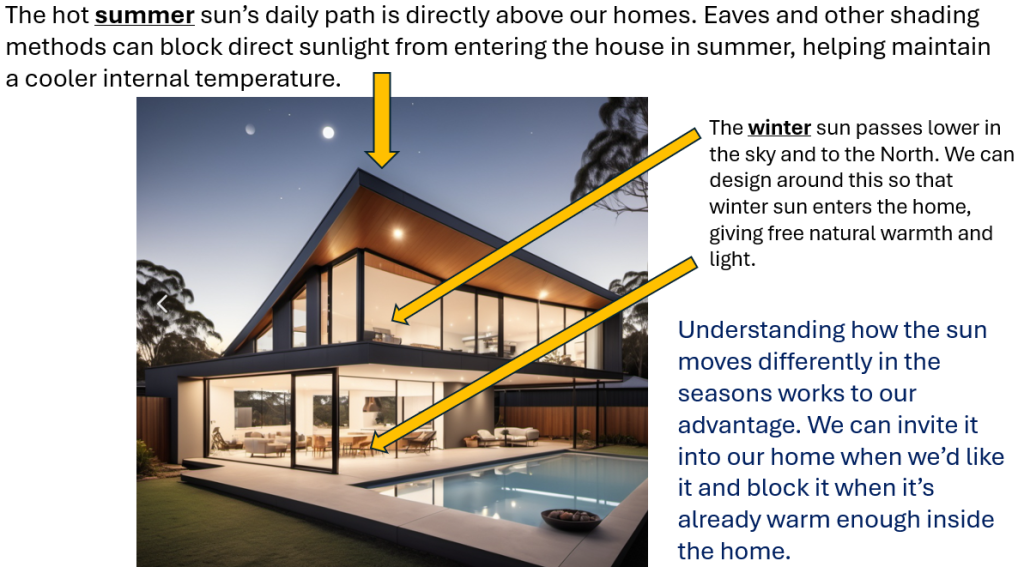
Image: North-facing Solar Passive Design principles for Victoria.

Image: A regional Victoria project with good solar orientation. Living rooms to the North are warmed naturally by the sun, whilst bedrooms on the cooler/ darker South side on the home retain good sleeping conditions.
Home Sites.
As we begin our design and planning for home orientation, we also need to understand the characteristics of our home’s site and consider its size, shape, orientation, shading, slope, and geology. Once our site is well understood we can then best design and place the home onto it.
At the design stage it’s possible to assess many different options of orientation, shading, room placement and other passive design aspects. At the design (pre-build) stage, changes are still easy, quick and cheap to make.
We have opportunities for our home to be more comfortable and energy efficient when we place it as best we can on the land site. Ideally we’d have a large piece of land and can optimise our solar orientation for maximum benefit, though sometimes there are unique site aspects to consider.
Sites with small size, odd shape, close neighbours and/ or steep slope, require more creative building design to achieve a comfortable, attractive, energy-efficient home, though a good set-up and orientation is still possible. Strategies for challenging sites include adopting a more compact building footprint for smaller sites, or re-designing living rooms (shape and placement) and their window specs to improve solar access on odd-shaped sites.
The future of your home site.
Thought also needs to be given to how future developments/ buildings nearby might affect your home. Future site overshadowing may not be preventable so we should consider designing with the assumption that neighbouring buildings will soon be close by. This is particularly important for apartment buildings in cities as another building will eventually be built nearby.
With careful thought we can future-proof the design, comfort and efficiency of our home.
The local microclimate and topography may also affect your home.
Examples:
- Coastal areas: are there cooling sea or land breezes that you can utilise?
- Built-up streets. Elevated ambient temperatures (from heat-sinks) can raise a suburb’s temperature by up to 5C. This is caused by dark surfaces such as roads and roof tiles absorbing and holding onto sun heat and we should allow for this.
- Site slope: specific design measures are needed to deal with a steep slope as it affects our solar access.
It’s useful to analyse your proposed home design on various different individual sites that you are considering building on to note if any site characteristics may be a concern and/ or if one site offers a ideal orientation opportunity,
Concerns could be: limited solar access (sunshine), difficult site direction and frontage, seasonal winds, views (will they come with a comfort cost?), over-shadowing by trees or existing buildings, slope, and or drainage. In addition, there could be potential climate change impacts (possible increased risk of flooding), tidal inundation, or heat-sinks in built up areas.
Good analysis can help to pick the best site for your home.
As we begin to design a home to work well on a particular chosen site, we then design to match the site’s specific orientation aspects.
‘Designing for the site’ considerations.
- Build close to the South boundary of the site, as this protects the home’s Northern solar access (from being built-out) and maximises sunny, north-facing outdoor living areas.
- Locate living areas on the North side of the home to take advantage of winter sun, taking care to ensure proper summer shading as well.
- Locate bedrooms on the South-side to maintain cooler and darker sleeping comfort.
- Plan openings for cooling summer breezes. Use correctly-shaded double glazed openable windows for cross-ventilation through the home.
- Plant deciduous trees on the North side to let winter sun in and to provide summer shade. Landscape using fences and plantings to channel cool breezes and block or slow harsh winds.
Shading Considerations.
Orientation works best when designed with good shading, allowing for that the sun moves East-West daily and also higher and lower across seasons. Shading a home well, particularly windows and other forms of glazing, can have a significant impact on summer comfort and energy costs. Appropriate shading design and structures can help to block unwanted (excess) sun in summer while still allowing solar access (gain) in winter.
- Shading can be fixed, such as eaves, fences and evergreen trees. It can also be adjustable such as external louvres, adjustable shade cloth, blinds and deciduous trees.
- For North-facing façades, an effective idea for solar shading is to design roof eaves to block out the excess sun in summer…yet also let in the lower angled sun in winter. Shade projections installed above glazing also work well, as seen in the image below.
No user effort is needed for these systems, they work passively all year round. - On East and West facing façades, often an adjustable/ seasonal system works best, partly as the sun is at a lower angle in the afternoon and could penetrate beneath the shade method when the sun is moving close to the horizon.

Image. This image shows the shade at one time of the year. As the level of shade here is ‘partial’, it suggests this photo was taken in either Autumn or Spring. Here ‘some’ (or optimum, for that season) sun was welcomed into the home, coming in through the windows and landing on the floor for heating.
Eaves and Eaves Width.
Correctly designed eaves are generally the simplest and an inexpensive shading method for northern elevations and are all that is required on most single-storey houses. An eave width should be around 50% of the height from the bottom windowsill to the bottom of the eaves. This ensures that north-facing glass can be fully shaded for a month during and either side of the summer solstice and receives full solar access during (and for a month either side of) the winter solstice.
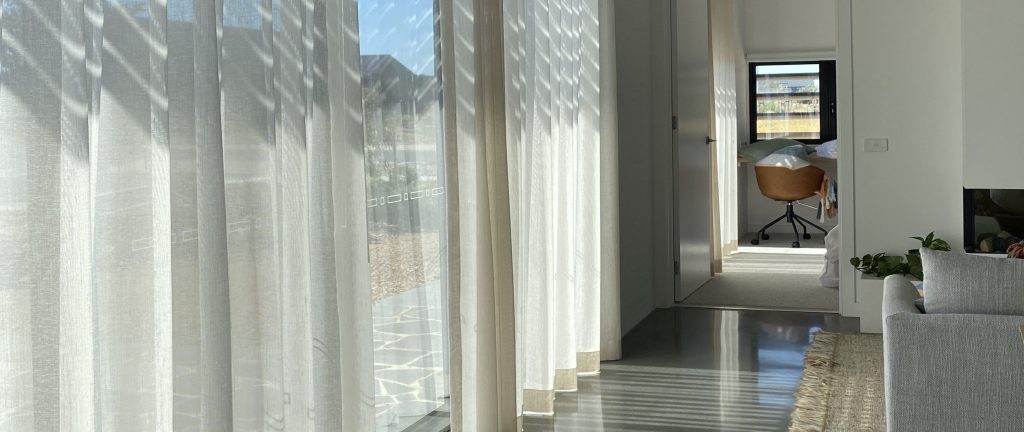
Image. Shading is calculated to allow winter sun to enter home, and also to block excess sunshine in summer. For this house, this window/shade/ thermal-mass combination is the only heating system needed in winter.
Establishing or retrofitting a garden can make a large difference with the light/heat falling onto and into a home. Decisions include choosing between deciduous and evergreen trees (for seasonal shading differences), tree size, shape and placement, and all these factors affect the temperature of a home. Planning and an early start with planting is needed as trees take some time to grow, though their long-term benefit is great. Once tall enough they can also keep direct sun off a building’s roof and stop unwanted heat absorption into the home via ceilings.
Windows.
Already discussed above as a material/component, windows are also a key element of correct orientation and need appropriate placement, size and type (double-glazed) to work well with the orientation to the sun. Each home’s situation is different as homes are of varied size, shape and layout, as are the sites they sit on.
The principles below can be followed when choosing glazing (windows) to optimise the thermal performance of your home in Southern Victoria:
- Locate and size the glazing (and its shading) to let in sunshine in colder months, and exclude the sun in hot months.
- Design/ install/ place thermal mass to match the windows, so as to absorb the winter sun’s heat into the building, for natural warmth in cold seasons.
- Locate window and door openings to allow natural cooling by cross-ventilation.
For retro-fits (established homes), revised orientation options are often available also, such as alterations to room-use and to windows (location, size, shading), skylights and external shading.
Example 1: if a bedroom is receiving the best winter sun but the living room is dark, they can be swapped around in use for immediate benefit.
Example 2: if a kitchen window is on the darker South wall, adding even a small new window to the East wall to receive the morning Winter sun would make a big difference to the amount of light entering the kitchen.
ACCLIMATISATION THROUGH INTERNAL ROOM PLACEMENT (IRP).
Internal room placement is the consideration of how to best lay-out a building’s floor plan internally in terms of comfort, energy use and sustainability. Following on from orientation of the whole building to the sun’s path, we next plan the best position and details of different individual rooms.
Here we consider how rooms interact, the different room-uses and room-use patterns, the time of their use (day or night?), their length of use and their heating/cooling requirements.
IRP Considerations.
- Plan your most preferred day-time winter-time sunny areas specifically, such as designing for the mid-day winter sun to land on a living room sofa. Generally place your daytime living areas and family rooms to the North, to maximise natural daylight and winter sun in those areas.
- Set home ‘zones’ of similar-room uses to reduce heating and cooling needs. Example: situate bedrooms together on the South side to create a cool, dark, quiet sleeping zone.
- Place garages to the West to block excessive summer afternoon-sun to other rooms.
- Place kitchens (usually East) where they receive the morning sun.
- Avoid putting ‘non-use’ rooms like garages where they may take the best winter sun or block winter sun to living rooms.
- Avoid western positions for bedrooms, to avoid a hot and bright summer afternoon sun in sleeping rooms.
- Design wet-rooms together to save on water heat-loss from longer pipes.
Group unheated rooms (garage, laundry) also. - Include (+ close) internal doors to close-off areas not in use, and at stairs to stop up and down drafts and heat-exchange.
- Consider airflow and cross-ventilation in the design stage to pre-set a path and control the air flow passage across the home.
Not all above options can be applied to every home, though adopting even a few of these can make a huge difference to comfort.
Airlock. (See image below).
An airlock is a small room (usually 2m ~ 8m2) placed at an external door to prevent unwanted exchanges of the home’s air when the external door is open. If a home is sitting at a comfortable temperature of 20℃, and (for example) it’s cold and windy outside, an open external door may result in a quick air exchange that leaves the home at (say) 9℃. Correct use of an airlock would mean that only the air in the airlock room was exchanged, whilst the rest of the home is still comfortable at 20℃. Airlocks should be strongly considered in particularly windy regions but offer benefits in all hot and cold climates and cost nothing to run.
Climate Room.
For homes where large structural changes for orientation are not possible (perhaps due to cost), a ‘climate room’ may be the best improvement option. This is where a high-use room type, such as a living room, is given priority and is placed in the best location for its use.
For example, the conversion of a North-facing but seldom-used dining room into a sunny sitting room is a great way to bring natural comfort to a high-use room. Insulating that room well would further add to its comfort.
A climate room is a good solution for a person who will spend a great amount of time in that updated room and who would benefit greatly from its retrofit. We can utilise what we know about the sun’s movement, about shade options, insulation and other TACTICS principles to make a room comfortable and suitable for a new use. For when it’s not possible to apply TACTICS to a whole home, adapting part of a home (perhaps just a room) is the next best option.

Acclimatisation of housing generally.
More generally, in addition to Orientation and IRP, Acclimatisation of housing refers also to designing or modifying homes so they can naturally work with their surrounding environment. This results in improving a home’s comfort, energy efficiency, and resilience to climate conditions.
Additional aspects of housing acclimatisation includes also ‘Disaster Resilience’, the designing homes to withstand extreme weather such as excessive rainfall, damaging hail and/ or extreme heat events. Considering the extremes of your local climate and ensuring your home can withstand them is vital. Each year this appears more and more important.
An example of an ‘extreme’ that now occurs more regularly, is our hotter climate, longer summers and the related ‘Solar Oven’ problem. Whilst not as dramatic as a ‘disaster’, it’s a significant and growing issue, caused often by a wide expanse of glazing (or ‘too many poorly designed windows’) in a modern home and an extended summer (due to climate change.) This can allow the sun to override usual shade mechanisms and fill the home with excess summer heat. (Alan Pears, RMIT, April 2025.)


Stay connected! Follow us on our blog or socials for the latest updates, education and much more!
Quick Links
Get In Touch
© All Rights Reserved.